

Last Updated: November 6, 2026
Quick Summary
Expensive crystals are worth the price when rarity, quality, color and clarity, and carat weight justify the cost, and when the seller reports all four grading factors separately. Compare price per carat only among stones of similar color, clarity, and cut, and treat most crystals as a cost rather than an investment.
- A crystal's price comes down to rarity, quality, color and clarity, and how much material you get.
- Price per carat is the fairest way to compare two pieces of different sizes.
- Ask for color, clarity, cut, and carat reported separately, not as a single grade.
- Most colored stones are graded by the seller or an independent lab, not a universal scale.
- If a piece lost half its resale value tomorrow, would you still be glad you own it?
Table of Contents
- What Actually Drives the Price of Expensive Crystals
- Gemstone Grading and Price Per Carat Explained
- How to Tell If Crystals Are Fake Before You Pay Premium Prices
- Ethically Sourced Crystals Meaning: What the Label Should Tell You
- How to Source Ethically Mined Crystals Online
- Where to Buy Ethically Sourced Crystals That Match the Price
- Resale Value and Investment Risk: When a Crystal Is a Cost, Not an Asset
- Find Your Next Intention Piece at The Crystal Flame
- Frequently Asked Questions
What Actually Drives the Price of Expensive Crystals
A crystal's price comes down to four things: how rare it is, how hard it is to find in good quality, what color and clarity it shows, and how much material you get. That is the short answer to whether expensive crystals are worth the price. This guide from The Crystal Flame breaks down what you are actually paying for, so you can judge a premium piece on evidence rather than on a pretty photo.
The first thing to understand is that price is not a single number. It is a stack of decisions made before the stone ever reaches a shelf.
Rarity, Availability, and Demand
Rarity drives price more than beauty does. A stone found in one region, or in deposits that are running thin, costs more to bring to market than a common mineral dug on several continents.
Demand pushes the other direction. A trendy stone can spike in price while supply catches up, then settle once more material reaches buyers. Watch for stones sold on scarcity claims alone. Ask what makes this piece scarce, and whether the seller can name the origin.
Color, Clarity, Cut, and Carat Weight
Color is the first thing most buyers notice, and it usually carries the biggest premium. Deep, even saturation commands more than pale or patchy tones.
Clarity covers internal flaws and how visible they are. Cut matters for faceted stones, where symmetry and polish control how light moves through the piece. Carat weight is simply size, and price per carat climbs faster than weight does once you pass common sizes.
Gemstone Grading and Price Per Carat Explained
Gemstone grading is the practice of sorting a stone by color, clarity, cut, and carat weight so buyers can compare pieces on the same terms. Price per carat is the stone's total price divided by its weight, and it is the fairest way to compare two pieces of different sizes.
The four factors do not act independently. They multiply. A stone with top color but visible inclusions can price below a slightly paler stone with clean clarity, because the market punishes flaws more than it rewards saturation once clarity drops below a threshold. That is why a single "grade" label tells you less than the four factors reported separately.
Here is how the four grading factors translate into money:
| Value Factor | What Buyers Look For | Effect on Price |
|---|---|---|
| Color | Deep, even saturation | Strongest premium |
| Clarity | Few visible flaws | Raises price sharply |
| Cut | Symmetry and polish | Big lift on faceted stones |
| Carat weight | Larger finished piece | Price per carat climbs with size |
How Price Per Carat Actually Behaves
Price per carat is not linear. Small stones are cheap per carat because they are common. As weight climbs, price per carat rises, and it rises fastest at the size thresholds where fine material becomes scarce.
A simple comparison shows why price per carat matters. A small, clean, richly colored piece can cost more per carat than a larger, paler one. Compare on that basis and the premium starts to make sense, or it does not.
Reading a Grading Report Without Overpaying
Most colored stones are not graded on a universal scale the way diamonds are (gia.edu). Colored stones are usually graded by the seller or an independent lab using descriptive terms. That means two sellers can both call a stone "AAA" and mean different things.
Use these steps to compare listings on equal footing:
- Ask for the four factors reported separately, not as a single grade.
- Ask whether the stone is natural, lab-grown, or treated, and which treatment.
- Request the per-carat price so you can compare against similar listings.
- Ask for the measurements in millimeters, not just carat weight, because cut proportions change how large a stone looks.
- Compare at least three listings of similar color and clarity before deciding.
Watch out: a seller who will not break out color, clarity, cut, and carat separately is hiding which factor is weak, and that is usually the factor you are overpaying for.
Where Grading and Price Per Carat Meet
The practical rule: compare per-carat prices only among stones of similar color, clarity, and cut. If you compare a top-color stone to a pale one on price per carat, the pale stone looks like a bargain when it is simply a different product. Grade first, then compare price per carat within that grade band.
How to Tell If Crystals Are Fake Before You Pay Premium Prices
Fake crystals usually give themselves away through uniformity, weight, and temperature. Natural stones vary from piece to piece, feel cool and dense in the hand, and show small irregularities.
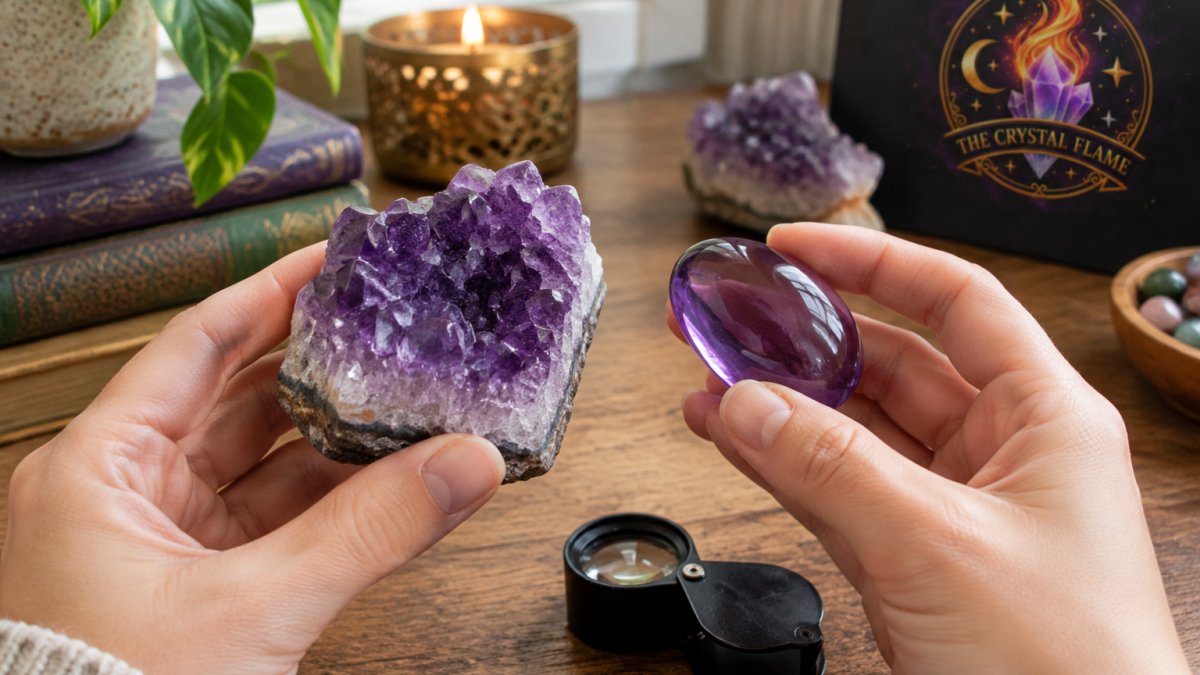
Run through this checklist before you commit:
- Ask the seller to name the origin and the treatment, if any
- Compare the piece to the listing photo and expect natural variation
- Look for bubbles, seams, or a too-perfect surface
- Check weight and temperature in the hand
- Request a close-up video in natural light
- Confirm the return policy in writing
For a deeper walkthrough, read our guide on how to tell if crystals are fake before you pay a premium.
Watch out: a listing that shows one flawless photo and no origin details is the most common way buyers overpay. Ask for the specific piece you will receive.
Ethically Sourced Crystals Meaning: What the Label Should Tell You
Ethically sourced crystals meaning is straightforward: the stone was extracted and traded without harming workers, communities, or the environment, and the seller can trace where it came from. The label should tell you the country or region of origin and how the material was obtained.
Vague claims like "responsibly sourced" mean little on their own. A credible seller names the mine region, describes the supply chain, and answers follow-up questions without hedging. If a shop cannot say where a stone came from, treat the ethical claim as unproven.
How to Source Ethically Mined Crystals Online
Sourcing online starts with the seller, not the stone. Look for shops that publish origin details, show the actual piece, and explain their sourcing approach in plain language.
Then verify. Ask questions before buying, read the shop's sourcing page, and check whether the return policy protects you if the piece does not match its description. Buyers who ask two or three specific questions up front tend to end up with better pieces and fewer surprises.
Our step-by-step article on how to source ethically mined crystals walks through the questions worth asking.
Where to Buy Ethically Sourced Crystals That Match the Price
Buy where the listing gives you enough detail to justify the number. That means origin, grade, and a photo of the piece you will actually receive, not a stock image.
At The Crystal Flame, we curate over 700 mystical products and choose each item with intention. Our Uruguayan Amethyst Love Heart Cluster is hand-carved from Genuine Uruguayan Amethyst and listed as AAA grade, so you can check its description against the grading factors above.

Best for: buyers who want a high-grade statement piece with a clear description. Skip if: you want a small, low-cost stone to start with.
Resale Value and Investment Risk: When a Crystal Is a Cost, Not an Asset
Most crystals are a cost, not an asset. Resale value depends on demand, grading, and provenance, and it is rarely guaranteed. Treat any purchase as money spent on something you enjoy, not as an investment with future returns.
The reason is structural, not a matter of picking the wrong stone. Retail prices include the seller's margin, marketing, and overhead. A buyer who resells usually sells into a wholesale or secondary market that pays a fraction of retail.
The Four Things That Decide Whether Resale Is Possible
- Liquidity. Fine gemstones trade through dealers, auctions, and private networks, not storefronts. A stone with no established buyer pool can sit unsold for months regardless of quality.
- Transaction costs. Consignment fees, shipping, insurance, and appraisal costs eat into any gain. A piece needs to appreciate meaningfully just to break even.
- Demand stability. Trends move. A stone that is fashionable this year can soften when supply catches up or buyer attention shifts, and price follows demand rather than intrinsic beauty.
- Documentation. Independent grading reports and provenance records make a stone easier to resell because the next buyer can verify what they are getting. Without paperwork, resale is harder and the price is lower.
What "Investment Grade" Actually Means
Genuinely rare material, top-color stones from limited sources, large clean pieces, and well-documented collector specimens, has a better chance of holding value because supply cannot expand quickly.
There are exceptions. Genuinely rare material, such as our Pink Kunzite Pendant, is positioned on scarcity, and scarcity is what gives a collector piece a chance at holding value.

Watch out: a seller who frames a crystal as an investment without naming the resale channel, the documentation, and the transaction costs is selling a story, not a market.
The Honest Test Before You Buy
The honest test: if the piece lost half its resale value tomorrow, would you still be glad you own it? If yes, the price is easier to justify. If the answer depends on recovering your money, the purchase is a speculation, and it should be sized like one, small enough that a total loss does not change your finances.
Find Your Next Intention Piece at The Crystal Flame
Choosing well comes down to matching the stone to what you want it for. Color, origin, and grade tell you what a piece is. Intention tells you whether it belongs in your home.
If you are unsure where to start, our guide on how to choose crystals for energy can help you match a stone to your intention. Then browse our collection with those criteria in hand.
The challenge with expensive crystals is separating real value from a good photograph.
Frequently Asked Questions
Are expensive crystals worth the price compared to cheaper ones?
It depends on what you are buying for. Higher prices usually reflect rarity, color saturation, size, and provenance, not a guarantee of better energy. Judge expensive crystals by visible quality, seller transparency, and whether the piece fits your practice. If a seller cannot explain why a stone costs more, the premium is decoration, not value.
How can you tell if a crystal is real or fake?
Look for natural variation: no two genuine stones share identical color banding, inclusions, or surface texture. Glass imitations often show tiny round bubbles and uniform color. Ask the seller for origin details and whether the stone is natural, lab-grown, or treated. A real stone should feel cool and weighty for its size. When in doubt, request close-up photos in natural light, since studio lighting hides flaws and exaggerates shine.
What does ethically sourced crystals mean, and does it affect price?
Ethically sourced crystals meaning covers stones mined with fair labor, minimal environmental damage, and traceable supply chains. Ethical sourcing can raise prices because verified mines cost more to operate, but it also reduces risk of counterfeit or mislabeled stones. Ask sellers how they source ethically mined crystals online, whether they name the country of origin, and whether they can document the supply chain. Vague claims like 'ethically sourced' without detail are marketing, not proof.
Where can I buy ethically sourced crystals without overpaying?
Start with shops that publish origin details, grading standards, and clear return policies. The Crystal Flame's catalog includes a range of pieces, such as a tumbled serpentine pocket stone and amethyst clusters, so you can compare options at different price points. Compare price per carat or per gram, read the listing carefully, and buy from sellers who answer sourcing questions directly.
