

Last Updated: November 5, 2026
Quick Summary
To source ethically mined crystals, ask the seller for a specific country, region, or mine, and request documentation such as an invoice or chain-of-custody record for the exact lot you are buying. Sellers who answer those questions clearly and admit what they cannot confirm are usually the most trustworthy.
- Ask for a specific country, region, or mine rather than a vague "ethically sourced" label.
- Request an invoice or chain-of-custody record for the specific lot you plan to buy.
- A generic sourcing policy or certificate of authenticity is not proof of where a stone came from.
- Ask whether the seller buys direct from miners, through brokers, or at trade shows.
- Consider recycled, vintage, or secondhand stones to avoid new mining altogether.
Table of Contents
- Why Mining and Sourcing Ethics Matter for Crystals
- How Crystal Mining Affects the Environment
- How to Verify Crystal Origin Before You Buy
- Questions to Ask Crystal Sellers About Sourcing
- Finding Ethically Sourced Crystals Online
- Labor Conditions and Fair Treatment in Crystal Mining
- Choosing Your First Ethically Sourced Crystal at The Crystal Flame
- Frequently Asked Questions
Why Mining and Sourcing Ethics Matter for Crystals
Learning how to source ethically mined crystals starts with understanding where your stones come from. Every seeker deserves to know the story behind the stone in their hand.
Ethical sourcing means the stone was found, cut, and shipped in ways that respect the environment and the workers involved. It is not a single label. It is a set of practices you can check, question, and compare.
Many shoppers now ask where their crystals come from before they buy. Sellers who can answer those questions clearly tend to earn more trust over time.
- Mining can disturb habitats and leave land scarred (the EPA)
- Workers may face unsafe conditions or unfair pay
- Clear sourcing information helps you make a choice you feel good about
How Crystal Mining Affects the Environment
Crystal mining can leave lasting marks on the land around it. Digging removes soil, clears plants, and can change how water moves through an area. Small-scale mines often lack the equipment or rules that larger operations use to limit damage.
Water use and pollution are also concerns (the EPA). Washing and processing stones can send sediment and chemicals into nearby streams if nothing is done to contain them.
Shoppers who want a lower-impact choice can look for sellers who explain how their stones were recovered. Recycled, vintage, or secondhand stones avoid new digging altogether.
How to Verify Crystal Origin Before You Buy
Verifying origin means asking where a stone was mined and how it reached the seller, then checking whether the answer is backed by records rather than adjectives. Start with the country or region listed on the product page.
!Close-up of hands holding a raw, unpolished crystal beside a notebook with a written sourcing checklist in a softly lit home workspace
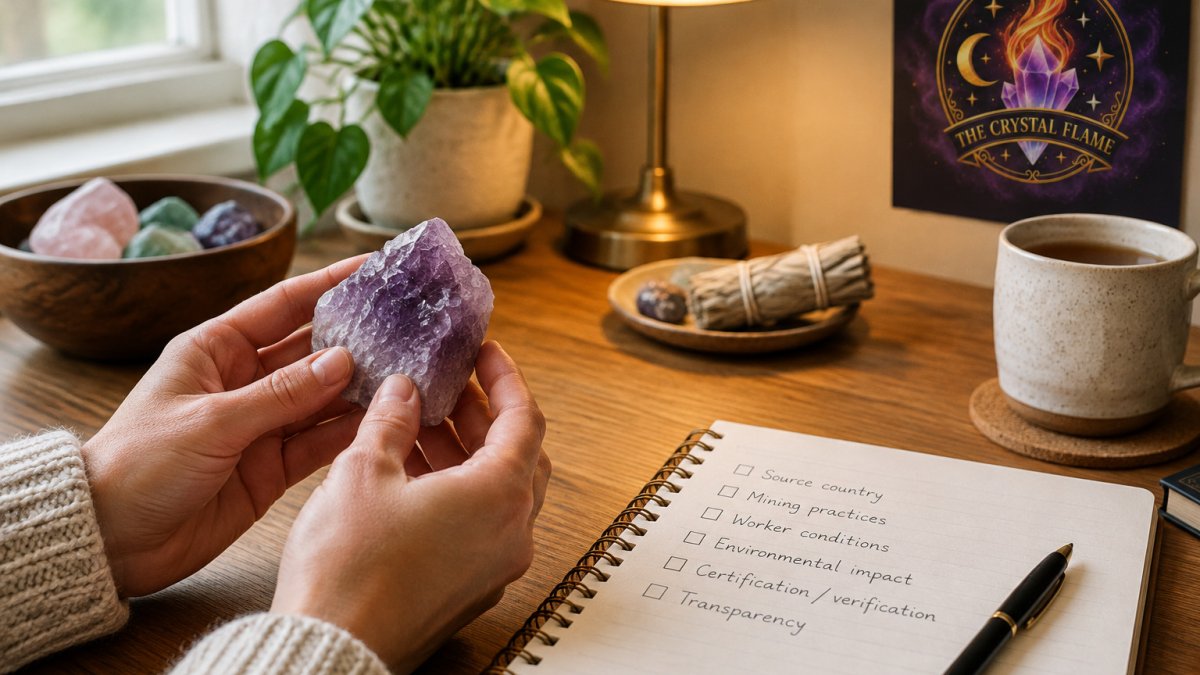
Tracing a Crystal From Mine to Finished Piece
A stone usually moves through several hands before it reaches you. The typical path looks like this:
- Extraction, the stone is dug at a mine, or picked up by a local miner or small cooperative working a surface deposit
- Local dealer or broker, rough material is bought, sorted by grade, and aggregated with stones from other diggings
- Export, the rough is consolidated into a shipment, often mixed with material from multiple mines in the same region
- Cutter or polisher, the stone is shaped, tumbled, or faceted, frequently in a different country from where it was mined
- Wholesaler, finished pieces are bundled into lots and sold to retailers, sometimes through more than one intermediary
- Retailer, the shop you buy from, which may have bought direct, through a wholesaler, or at a trade show
Each handoff is a place where the record can break. The most common loss points are the broker stage, where rough from many small mines is pooled, and the cutting stage, where stones from different lots are processed together. That is why a retailer can honestly say "this came from Brazil" while having no idea which mine, which miner, or under what conditions.
Ask sellers whether they buy direct from miners or through middlemen, and whether they keep invoices for each stage.
What Verification Documents Can and Cannot Prove
Different documents establish different things. Knowing which is which keeps you from over-trusting a claim:
- A purchase invoice shows that money changed hands between two businesses for a described quantity of goods. It does not prove where the stone was mined or how workers were treated.
- A mine name or location record narrows origin to a specific site or region. It does not confirm labor conditions or environmental practices at that site.
- A chain-of-custody document tracks a lot through named handlers from mine to retailer. It is the strongest paper evidence of traceability, but only as good as the honesty of each party who signed it.
- A third-party audit or certification indicates that an operation was assessed against a standard at a point in time. It does not guarantee every stone in every shipment came from the audited operation.
- A seller's own sourcing policy states intent and standards. It is not evidence unless the seller can show records behind it.
Treat any claim of "100% ethical" with caution. A more honest seller will describe what they know, what documentation they hold, and what they cannot confirm. Watch out: a certificate of authenticity that describes the stone's type, weight, or treatment is not a sourcing document, it says nothing about where the stone came from or who mined it.
A Seller-Vetting Checklist You Can Reuse
Use the same short checklist every time you consider a purchase. Score each line as documented, claimed, or unknown:
- Origin specificity, Does the listing name a country, region, or mine, or only a vague "imported" label?
- Supply-chain description, Does the seller explain whether they buy direct, through a broker, or at trade shows?
- Documentation on request, Will they share an invoice, mine record, or chain-of-custody document for the specific lot you are buying?
- Consistency, Does the sourcing story on the product page match what the seller tells you in a direct reply?
- Willingness to say "I don't know", Does the seller distinguish what is verified from what is assumed?
- Alternatives offered, Do they stock vintage, recycled, or secondhand stones for buyers who want to avoid new mining?
A seller who welcomes these questions and answers them plainly is usually a seller worth trusting. A seller who deflects, answers only in slogans, or cannot produce a single record for a specific lot is telling you something too.
Questions to Ask Crystal Sellers About Sourcing
Asking the right questions is one of the most useful steps you can take, but the value comes from knowing what a good answer sounds like.
**1.
**2.
Rough Lapis Lazuli – Raw Stone from India →
3. Can you share documentation for this specific lot? Ask for the document, not a promise of one.
4. How do you handle worker pay and safety at your suppliers? Most small crystal mines are informal or family-run, so few sellers will have audit reports.
**5.
6. What can you not confirm about this stone? This is the question most sellers never hear, and it is the most revealing.
How to Compare Answers Across Sellers
Keep a simple record as you shop. For each seller, note the origin given, the supply-chain path described, the documents offered, and whether the direct reply matched the product page.
A seller who welcomes these questions is usually a seller worth trusting. The follow-up matters as much as the first answer.
Use these questions to judge whether a seller's sourcing claims are backed by real records.
| Question | Strong answer | Weak answer |
|---|---|---|
| Which country, region, or mine? | Names a specific region, area, or cooperative | Only "Africa" or "ethically sourced" |
| Direct, broker, or trade show? | Describes each supplier handoff | Avoids describing the supply chain |
| Documentation for this lot? | Invoice, mine record, or chain-of-custody | Generic policy PDF or authenticity certificate |
| Worker pay and safety at suppliers? | Explains how suppliers are chosen and checked | Vague talk of "fair practices" |
| Recycled or secondhand options? | Stocks vintage or secondhand stones | Treats ethics as a single product line |
| What can you not confirm? | Names the limits of what is known | Claims complete certainty |
Finding Ethically Sourced Crystals Online
Online shopping makes sourcing harder because you cannot inspect the stone first. Look for product pages that list origin, size, and sourcing notes in plain language.
Search for ethically sourced crystals online by checking how a shop describes its suppliers.
- Read the origin details on each listing
- Check whether the shop explains its supply chain
- Compare any sourcing claims with what the seller says in reply to your questions
Labor Conditions and Fair Treatment in Crystal Mining
Many crystal mines are small, family-run, or informal. Workers in these settings may lack protective gear, steady income, or a way to report unsafe conditions.
Fair treatment means workers are paid for their time, kept safe, and free from exploitation.
Ask sellers how they choose their suppliers and what standards they expect from them. A clear answer shows they have thought about the people behind the stones.
Choosing Your First Ethically Sourced Crystal at The Crystal Flame
Starting out does not require a large budget. A simple stone you can learn from is a good place to start. Consider these raw options:
- Rough Lapis Lazuli - Raw Stone from India ($7.95) is a deep blue stone with gold pyrite flecks, suited to those drawn to wisdom and self-expression. Rough Lapis Lazuli - Raw Stone from India
- Rough Chalcopyrite - Raw Stone from Mexico ($14.95) shows a rainbow surface that shifts with the light, a good pick for a shelf or altar. Rough Chalcopyrite - Raw Stone from Mexico
- Rough Rainbow Moonstone - A+ Grade Raw Stone from India ($7.95) has a soft blue sheen, often chosen for intuition and reflection. Rough Rainbow Moonstone - A+ Grade Raw Stone from India
- Rough Pink Opal - Raw Stone from Peru ($4.95) offers a gentle pink tone and is an easy first stone for a bedside table. Rough Pink Opal - Raw Stone from Peru
For a simple start, browse our Citrine Crystal Untreated Rough Raw Stones By The Piece Or Pound or the Clear Quartz Crystal Tumbled Stones By The Piece Or Pound, and ask us about origin before you order.


Frequently Asked Questions
Where can I get ethically sourced crystals?
Look for online shops that name the mine or country of origin for each specimen, describe how stones were collected, and answer sourcing questions directly. The Crystal Flame's Rough Stones collection includes pieces such as Rough Lapis Lazuli from India for $7.95 and Rough Chalcopyrite from Mexico for $14.95. Origin labels are a starting point, not proof, so ask the seller how they know where the stone came from and what documentation supports it. Buying from sellers who explain their sourcing openly makes it easier to judge their claims.
Can crystals be ethically sourced?
Yes, but ethical sourcing is about specific practices, not a single label. A stone can be ethically sourced when it comes from a mine with fair labor conditions, limited environmental damage, and a documented chain of custody from the mine to the seller. Many crystals are mined by small-scale or artisanal miners, and their working conditions vary widely. No single certification covers every crystal, so buyers usually need to combine seller transparency with the questions they ask about each stone.
How can I verify where a crystal was mined?
Start with the origin the seller lists, then ask for supporting details such as the mine name, region, the supplier's name, and how the stone was transported. Compare the mineral's known sources with the claimed origin. For example, Lapis Lazuli is traditionally associated with mines in Afghanistan, so an Indian origin would prompt more questions. Verification has limits: paperwork can be incomplete, and a supplier may not know the exact mine, so note what you can confirm and what you cannot.
What should I ask a crystal seller about sourcing?
Ask where the crystal was mined, who collected it, how the miners were paid, and whether the supplier can provide documents or photos from the source. Ask how long the stone has been in the supply chain and whether it was processed or cut before it reached the store. Reliable sellers answer these questions specifically. Vague answers, such as calling a crystal ethical without naming a source, are a warning sign.
Sign up for our newsletter to hear when new ethically sourced stones arrive at The Crystal Flame.
