

Last Updated: October 30, 2026
Quick Summary
Learning how to tell if crystals are fake starts with knowing that fake crystals pretend to be a mineral they are not, like glass sold as quartz or dyed resin shaped like turquoise. Check for uniform color, dye pooled in cracks, and round bubbles, since natural stones show variation and internal fractures. Home tests narrow the field but cannot prove origin, so confirm with a seller who discloses treatment and origin.
- Fake means the material is not what the label says, such as glass, plastic, or resin.
- Real stones shift in tone across the surface, while imitation tends to look flat.
- Hold the stone against a plain white background in daylight, since fluorescent light hides too much.
- Skip the scratch test and flame test, which can ruin soft stones or release fumes.
- For clear quartz, look for flaws, because perfectly clear quartz at a low price is often glass.
Table of Contents
- How to Tell If Crystals Are Fake: Start With the Four Categories
- Visual Signs of Fake Crystals: Color, Inclusions, and Surface Texture
- Crystal Authenticity Tests You Can Do at Home Safely
- How to Tell If Clear Quartz Is Real and How to Spot Fake Malachite
- Ethical Crystal Sourcing and How to Vet Online Listings
- Choose a Stone You Can Trust From The Crystal Flame
- Frequently Asked Questions
How to Tell If Crystals Are Fake: Start With the Four Categories
Fake crystals are stones that pretend to be a mineral they are not. Glass sold as quartz belongs here.
Imitation means a different material standing in for a stone.
Treated stones are real. Heat, dye, or resin has changed how they look, and honest sellers say so.
Lab-grown crystals are real crystal, made in a lab instead of the ground. Same chemistry, different origin.
Fake, Imitation, Treated, and Lab-Grown: What Each Label Means
Here is the distinction that matters most when you shop.
- Fake: the material is not what the label says at all. Glass, plastic, resin.
- Imitation: a real mineral sold as a different, pricier one. Common with dyed agate passed off as something rarer.
- Treated: genuine stone, altered on purpose. Heat-treated amethyst sold as citrine is the classic example.
None of these is automatically a scam. The scam is silence. A seller who tells you a stone is treated has done nothing wrong.
Visual Signs of Fake Crystals: Color, Inclusions, and Surface Texture
Your eyes often catch fakes before your hands do.
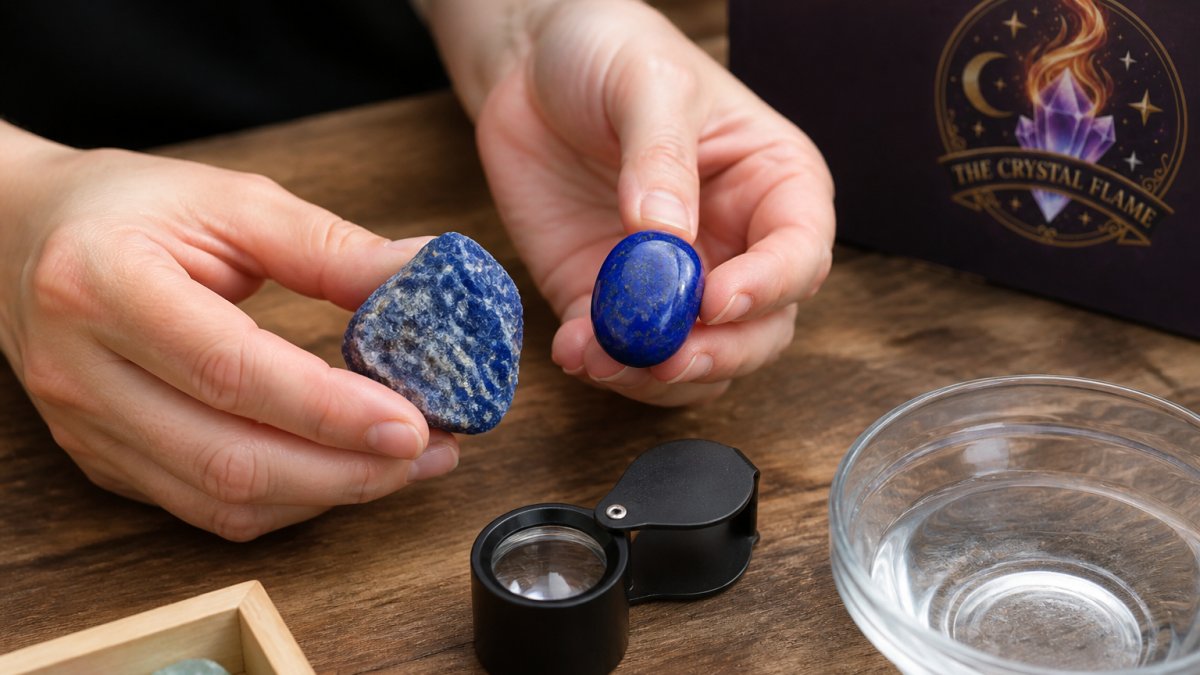
Uniform color is the first red flag. Real stones shift in tone across the surface.
Dye patterns collect in cracks. Look for color pooled darker inside fractures and lighter on the flat faces.
Bubbles are a glass signature. Round, perfectly spherical bubbles rarely appear in natural quartz. Irregular cavities do.
Natural inclusions are your friend.
Dye Patterns, Bubbles, and Uniform Color That Look Wrong
Hold the stone against a plain white background in daylight. Fluorescent light hides too much.
Turn it slowly. Real crystal changes as the light moves across it. Dyed stones tend to look flat no matter the angle.
Check the drill hole on beads. Dye often pools there, darker than the rest of the bead.
Crystal Authenticity Tests You Can Do at Home Safely
Crystal authenticity tests at home are useful, but they come with limits. They can raise your confidence. They cannot prove origin, and they are not a substitute for gemological testing. The table below ranks the common home checks by how much confidence they actually give you.
| Test | What it can tell you | Confidence level | Risk |
|---|---|---|---|
| Weight and density | Stone feels heavier than glass or resin of the same size | Moderate | None |
| Temperature (cool-to-the-touch) | A rough signal only; glass also feels cool at first | Low | None |
| Light test | Glass shows round bubbles; quartz shows internal fractures | Moderate | None |
| Magnification with a loupe | Reveals surface texture and internal structure | Moderate to high | None |
| Scratch test | Hardness comparison | Low to moderate | Can ruin soft stones like malachite |
| Flame test | Burn behavior of resin or dye | Low | Releases fumes; damages specimen |
| Chemical test | Acid reaction | Low | Damages specimen; unsafe at home |
Start with the safe ones.
- Weight: real stone feels denser than glass or resin of the same size.
- Temperature: natural crystal feels cool at room temperature and warms slowly in your hand.
- Light test: hold a thin edge up to a lamp. Glass shows bubbles; quartz shows internal fractures.
Weight, Temperature, Light, and Magnification Checks
The cool-to-the-touch test is the one people ask about most. It works as a rough signal, not a verdict. Glass feels cool too at first, and room temperature changes the result. Weight is more reliable. Compare two pieces of similar size. The heavier one is more likely to be stone.
When Home Tests Are Not Enough
Some questions cannot be answered at home. Whether a stone is natural, treated, or lab-grown often requires gemological equipment. If a piece is expensive, if the seller's claims are vague, or if the stone is one commonly faked (turquoise, lapis, citrine), professional verification is worth the cost. Ask the seller for a gemological report from an independent lab, and treat any refusal to provide one as a signal.
How to Tell If Clear Quartz Is Real and How to Spot Fake Malachite
General tests get you partway. Stone-specific clues get you the rest of the way, because the most common fakes cluster around a handful of popular minerals.
| Stone | Common imitation or substitute | Reliable non-destructive clue |
|---|---|---|
| Clear quartz | Glass, synthetic quartz | Natural quartz shows internal fractures, faint cloudiness, and slight color shifts; glass shows round bubbles and a too-perfect clarity |
| Amethyst | Dyed quartz, glass | Look for color zoning (darker at the tips, lighter at the base) and dye pooling in fractures |
| Citrine | Heat-treated amethyst, dyed quartz | Natural citrine is pale and slightly smoky; heat-treated amethyst often shows reddish-orange color concentrated at the tips |
| Tiger eye | Dyed quartz, resin | Real tiger eye has a silky chatoyant band that shifts as you rotate it; dyed imitations look flat and the color sits in cracks |
| Malachite | Resin, dyed stone, banded onyx | Real malachite has irregular swirling bands that never repeat exactly; fakes show printed or too-even banding |
| Turquoise | Dyed howlite, resin, compressed blocks | Natural turquoise shows matrix lines and color variation; dyed howlite shows dye concentrated in cracks |
| Lapis lazuli | Dyed jasper, glass | Real lapis has pyrite flecks and calcite streaks; dyed imitations show uniform blue with no mineral inclusions |
| Rose quartz | Glass, dyed quartz | Natural rose quartz is cloudy and translucent; glass is too clear and shows bubbles |
For how to tell if clear quartz is real, look for flaws. Perfectly clear, flawless quartz at a suspiciously low price is often glass.
For how to spot fake malachite, study the banding. Real malachite has irregular, swirling bands that never repeat exactly.
Ethical Crystal Sourcing and How to Vet Online Listings
Ethical crystal sourcing comes down to disclosure. A trustworthy seller tells you the stone, the origin, and any treatment, without you having to ask.
Vet listings with these checks:
- Does the listing name the specific stone and origin? Compare it with a listing like this rough rainbow moonstone from India.
- Does it mention treatment, or state that none was applied? See how a rough lapis lazuli raw stone listing states its origin.
- Are the photos of the actual piece, not a stock image?
Choose a Stone You Can Trust From The Crystal Flame
The final test is the seller, not the stone. Browse Sodalite Rough Chips to see the details for yourself.


Our Sodalite Rough Chips are offered in their raw, unpolished form. Each bag is unique, and chips vary naturally in size, shape, and color intensity.
Our collection of over 700 mystical products is chosen with intention, for curious beginners and seasoned practitioners alike.
Frequently Asked Questions
How can you tell if a crystal is real or fake?
Start with the four categories: fake (glass, resin, or plastic), imitation (a different mineral sold under a famous name), treated (heat or dye added to a real stone), and lab-grown. Then run safe checks: look for natural inclusions and uneven color, feel the weight and cool temperature, and inspect surface texture under magnification. No single home test proves authenticity, so combine several clues and ask the seller for disclosure before you buy.
What are fake crystals called, and how do they differ from imitations?
Fake crystals are usually glass, resin, or plastic made to look like stone. Imitations, also called simulants, are real minerals sold under another name, such as clear quartz passed off as diamond or dyed howlite sold as turquoise. Treated stones are genuine but altered with heat or dye, like heat-treated amethyst sold as citrine. Lab-grown crystals are real crystal structure grown in a lab. Each category carries a different value, so ask which one you are buying.
Can you tell if a crystal is fake by its color alone?
Color is a strong clue but not proof. Uniform, overly vibrant color, dye pooling in cracks, and a hue that does not match the mineral's natural range all suggest treatment or imitation. For example, most commercial citrine is heat-treated amethyst, and bright banded malachite is often a resin or composite. Compare the stone to reference photos of the natural mineral and look for variation, inclusions, and imperfections that natural stones usually show.
What should you ask a seller before buying a crystal?
Ask for the mineral name, whether the stone is natural, treated, lab-grown, or imitation, and where it was sourced. Request close-up photos in natural light and a disclosure of any dye or heat treatment. For higher-priced pieces, ask whether independent gemological testing is available. A seller who answers clearly and consistently is a better sign of ethical crystal sourcing than any single home test.
Fakes are common, and the labels are confusing. You do not have to sort it out alone. Browse our curated crystals and ritual tools, read the full description on every listing, and sign up for our newsletter for guidance on building a practice you trust. Get started with The Crystal Flame and choose stones with confidence.
