

Last Updated: November 1, 2026
Quick Summary
To do a tarot reading for yourself, prepare a quiet space, set one clear intention out loud, and ask an open question focused on what you can control. Start with a one-card or three-card spread, describe each card's imagery first, then apply its traditional meaning to your question.
- A tarot reading uses a deck of 78 symbolic cards for structured self-reflection, not fixed future prediction.
- The best questions to ask tarot cards are open, specific, and focused on what you can control.
- Tarot spreads for beginners should use one to three cards, such as a daily draw or three-card layout.
- Card interpretation means describing the image first, recalling the meaning second, and connecting it to your question third.
- A daily draw and one longer reading per week is a sustainable pace for most beginners.
Table of Contents
- Setting the Scene: Preparing Your Space and Intention
- Crafting Questions to Ask Tarot Cards
- Tarot Spreads for Beginners: Start Simple
- Reading the Cards: Interpretation Without Fear
- How Often to Do a Tarot Reading
- Build Your Practice with The Crystal Flame
- Frequently Asked Questions
Setting the Scene: Preparing Your Space and Intention
Learning how to do a tarot reading for yourself starts with one quiet moment. You do not need a special room or years of study.
A tarot reading is a structured moment of self-reflection using a deck of 78 symbolic cards. The cards do not predict a fixed future.
- Clear the surface. Wipe down a table and remove clutter. A clean space signals to your brain that this time is different.
- Lower the light. A candle or a lamp beats overhead bulbs. Soft light slows your breathing.
- Silence your phone. Notifications pull you out of reflection faster than anything else.
Intention setting separates a focused reading from a random card pull. Say what you want to understand before you shuffle.
Choosing a Deck That Feels Like Yours
Your first deck should feel good in your hands. That matters more than artwork reviews or what a forum recommends.
A beginner-friendly deck uses clear card imagery and keeps the traditional structure, so the Major and Minor Arcana follow familiar symbolism and you learn one system instead of two.
If you want everything in one box, the Classic Tarot Kit includes a classic 78-card tarot deck, a 112-page guidebook, a tarot cloth, and a digital tarot journal, priced at $27.99.

If you want the classic imagery most books reference, the Smith-Waite Tarot Card Deck offers Pamela Colman Smith's artwork in a borderless format with an instruction booklet, priced at $35.00.

Crafting Questions to Ask Tarot Cards
Here is the test we suggest. If your question could be answered with a single word, rewrite it.
| Instead of asking | Ask this |
|---|---|
| Will I get the job? | What should I focus on in this interview? |
| Is this relationship over? | What do I need to understand about this relationship? |
| Should I move? | What would help me decide about moving? |
| Am I making a mistake? | What am I not seeing about this choice? |
Query formulation improves fastest with practice. Ask one question per reading; two split your attention and blur the interpretation.
Avoid re-asking the same question because you dislike the first answer. That is anxiety seeking a different reply, and it trains you to distrust your own readings.
Tarot Spreads for Beginners: Start Simple
Tarot spreads for beginners should use one to three cards. A single card of the day or a three-card layout teaches you more than a ten-card spread you cannot remember.
- One-card draw. Pull a single card each morning. Note the first word that comes to mind.
- Three-card spread. Use it for a specific question once you know the deck.
- Two-card comparison. Pull one card for option A and one for option B. Useful for decisions.
The Three-Card Tarot Spread Meaning
The three-card tarot spread meaning depends on the positions you assign before you shuffle. The classic layout is past, present, and future, but that is only one option.
- Past, present, future. Good for understanding how a situation developed.
- Situation, action, outcome. Best for decisions where you want a next step.
- What helps, what blocks, what to notice. Useful when you feel stuck.
Decide the positions first. Write them down. Then shuffle. Changing the meaning after you see the cards is the most common way beginners accidentally lie to themselves.
Reading the Cards: Interpretation Without Fear
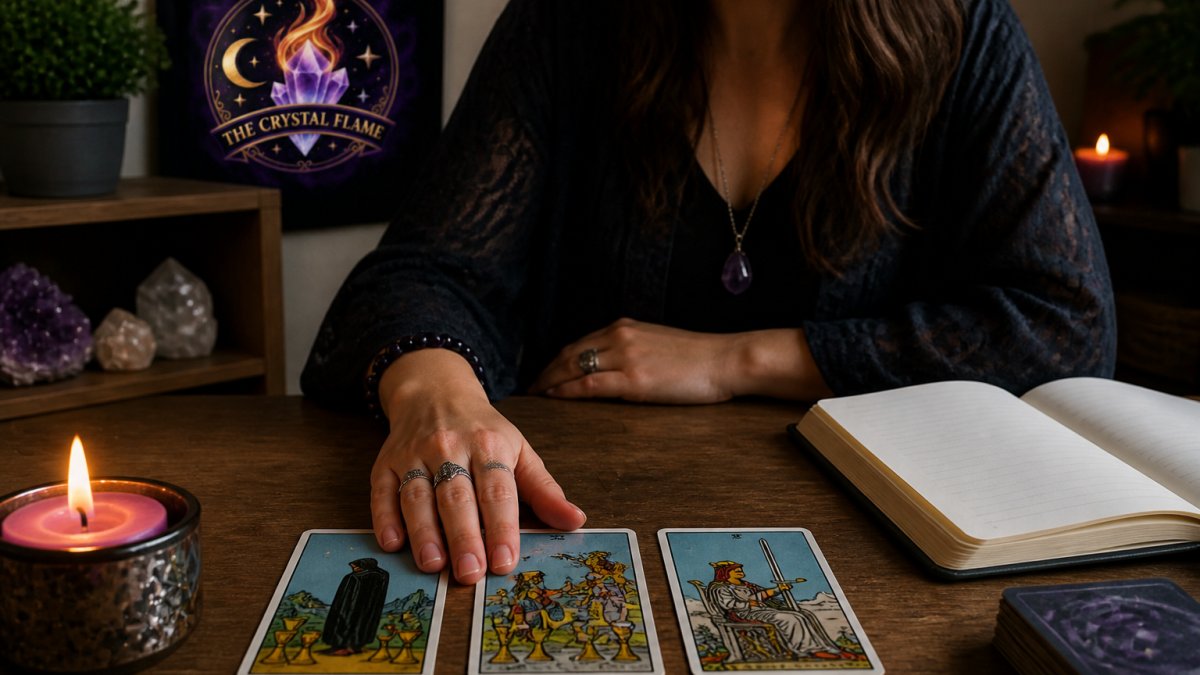
Card interpretation is the practice of reading symbolism in context, not memorizing 78 definitions. Start with what you see. Then layer in the traditional meaning. Then decide what fits your question.
- Pass one: describe the image. Who is in the card? What are they doing? What is the mood?
- Pass two: recall the meaning. What does this card traditionally signal?
- Pass three: connect it to your question. What does that combination say about your situation?
If you get stuck, the Tarot for Beginners guide walks through the Major and Minor Arcana in plain language and covers how to ask better questions.

Handling 'Bad' or 'Scary' Cards
Most self-reading guides skip the cards that make beginners want to put the deck down, but fear of a card is the fastest way to stop reading honestly.
Start with the principle: no tarot card predicts physical harm, death, or guaranteed disaster. The cards describe energies, patterns, and turning points. A frightening card is usually pointing at something you already sense and have been avoiding.
- Death. It is typically read as an ending rather than a literal death. In practice it marks an ending that has already begun: a job, a relationship dynamic, a self-image. Ask: "What is already over that I have not admitted is over?"
- The Tower. It points to sudden disruption and the collapse of a structure that was not stable. Ask: "What belief or arrangement am I propping up that cannot hold?"
- The Devil. It points to a pattern, attachment, or bargain holding you back, often one you participate in willingly. Ask: "Where am I trading freedom for comfort?"
A useful reframe for any challenging card: treat it as information, not a verdict. Write the card name at the top of a journal page and answer three prompts: What is this card showing me? What is within my control here? What is one small action I can take this week?
Naming and Managing Emotional Bias
Emotional bias is the real risk in a self-reading. You will read the cards you want to see and skim past the ones you do not.
Common bias patterns to watch for:
- Wishful reading. You interpret every card as a yes because you want a yes.
- Catastrophizing. You read every neutral card as a warning because you are already anxious.
- Re-asking. You pull the same question repeatedly until a card gives you the answer you wanted.
Name the tendency before you start: "I want a yes, and I will read honestly anyway." Naming it makes the bias visible enough to check.
A stronger safeguard is the blind first pass. Before you connect any card to your question, write one sentence describing the card as if you were explaining it to a stranger.
Grounding Before You Interpret
Grounding settles your nervous system before you read, because a panicked or rushed mind reads cards as threats and confirmations rather than information.
- Feet flat. Press both feet into the floor and notice the contact.
- Three slow breaths. Inhale for a count of four, exhale for a count of six. The longer exhale is what slows the heart rate.
- One sentence of context. Say where you are and what you are doing: "I am at my table, doing a reading about work."
- Set the bias check. Name the outcome you are hoping for, then set it aside.
This moves you out of panic and into objective perspective, and gives you a repeatable ritual that turns a hobby into a practice.
How Often to Do a Tarot Reading
A daily draw and one longer reading per week is a sustainable pace for most beginners. Daily pulls build deck connection fast. Weekly spreads give you enough distance to see patterns.
- Daily: one card, one sentence in your journal. Two minutes.
- Weekly: a three-card spread on one question. Fifteen minutes.
- Monthly: review the month's entries and look for repeated cards or themes. Twenty minutes.
Signs you are reading too often:
- You pull cards for the same question within a day
- You feel worse after a reading more often than better
- You cannot remember what you asked yesterday
Journaling is what turns a habit into a tarot practice. Record the date, the question, the cards, and what you felt. The Complete Tarot & Oracle Journal offers layouts for spreads and prompts for reflection, priced at $35.00.
Post-Reading Integration: From Insight to Action
Most guides stop at the reading. That is where the real work begins. Post-reading integration means giving a reading time to settle and then turning it into something you actually do.
- Close the reading. Write one sentence summarizing what the cards showed you. If you cannot compress it, you have not decided what it means yet.
- Name one action. Choose a single, small, concrete step you can take within seven days. "Ask my manager for feedback on the presentation" beats "be more confident."
- Set a review date. Put a reminder in your calendar for one week out. Revisit the entry and ask: did the action happen? Did the situation shift? Did the cards look different in hindsight?
- Log the outcome. Add a line to the journal entry noting what happened. Over months, this is how you learn which cards you read well and which you consistently misread.
This is the difference between divination and actionable self-reflection. A reading that changes nothing is entertainment. A reading that produces one honest action is a practice.
That gap between the reading and the review is where self-reflection turns into spiritual growth. For guidance on establishing an ongoing spiritual practice, see The Beginner's Guide to Starting a Spiritual Practice. Immediate reactions are usually bias; a week later, you can see what the cards were pointing at.
Build Your Practice with The Crystal Flame
Confidence builds from repetition, and repetition is easier when your tools feel right.
Our collection of over 700 mystical products is chosen with intention, from tarot and oracle decks to crystals and sound healing instruments. Free US shipping is available.
Frequently Asked Questions
What should I not ask in a tarot reading?
Avoid questions that pry into someone else's private life, such as asking about a partner's fidelity or a coworker's intentions. Skip yes/no questions that leave no room for nuance, and don't ask the same question repeatedly hoping for a different answer. Instead, frame questions around what you can control: 'What do I need to know about this situation?' or 'How can I approach this decision with clarity?' This keeps the tarot reading focused on your own growth and self-reflection.
Can I learn tarot by myself?
Yes. Most readers learn by doing daily draws, studying card imagery, and journaling their interpretations. Start with a beginner-friendly deck and a guidebook, then practice a three-card tarot spread each morning. You do not need a teacher or a certification to read for yourself. The key is consistency: a few minutes of practice each day builds deck connection faster than occasional long sessions. Many readers find that self-study deepens their intuition and personal symbolism over time.
Should I use reversed cards when reading tarot for myself?
Reversed cards are optional. Some readers find them useful for spotting blocked energy or internal resistance; others find they complicate beginner readings. If you are new, try reading all cards upright for the first month, then introduce reversals once you know the upright meanings well. There is no wrong choice. What matters is that you decide your approach before you shuffle and stay consistent, so your tarot reading stays clear and grounded.
How do I interpret tarot cards in a personal reading?
Start with the card's core meaning, then look at its position in the spread and how it relates to neighboring cards. Notice the imagery: what catches your eye first? That detail often carries the message. Pair the card meaning with your question and write down your first impression before checking a guidebook. Over time, you will build a personal vocabulary of symbolism. If a card feels confusing, sit with it and revisit your journal entry later; clarity often arrives after the reading.
The hardest part of a self-reading is trusting what you see. Start with one card a day, keep a journal, and let the pattern build. Get started with The Crystal Flame and find the deck, journal, and guidance that make your daily practice something you look forward to.
