

Last Updated: November 10, 2026
Quick Summary
To buy ethically sourced sound healing instruments, look for three verifiable claims: a named origin, a named maker or workshop, and documented material. Treat vague ethically sourced labels as decoration until the listing names a region, a workshop, and a specific material or alloy you can check.
- Handmade describes a technique, while ethically sourced describes a relationship with the maker.
- Ask for a photo of the exact piece you will receive before paying for anything expensive.
- Beginners need only three pieces: one sustained tone, one rhythmic element, and one precision tool.
- The 432 Hz Pure Harmony Set includes 3 quartz bowls, 2 mallets, and 3 rings for $769.00.
- Total cost of ownership includes mallets, rings, and cases, not just the sticker price.
Table of Contents
- Why Ethical Sourcing Changes What You Buy
- The Best Sound Healing Instruments by Category
- Ancient Sound Healing Instruments and Cultural Provenance
- Sound Healing Instruments for Beginners: Start With Three Pieces
- How to Buy Ethically Sourced Sound Healing Instruments Online
- Comparing Sets, Sizes, and Total Cost of Ownership
- Choosing Your First Set From The Crystal Flame
- Frequently Asked Questions
Why Ethical Sourcing Changes What You Buy
When you buy ethically sourced sound healing instruments, you are not just buying a bowl or a gong. You are choosing a supply chain.
This guide walks through what those claims actually mean, which ones you can verify, and how to compare instruments without getting lost in mystical marketing language.
Here is the tension most buyers miss. A handmade instrument and an ethically made instrument are not the same thing. "Handmade" describes a technique. "Ethically sourced" describes a relationship.
That distinction matters more for sound healing than for most categories. These instruments are used in meditation, sound baths, and personal practice. Many buyers want the object to carry clean intentions.
The Three Sourcing Claims That Actually Hold Up
Most sellers make vague statements. Three kinds of claims survive scrutiny.
Named origin. "Made in India" is a country label. "Handcrafted in a family workshop in the Kathmandu Valley" is a claim you can test.
Named maker or workshop. If a seller can tell you who made the instrument and how long the workshop has operated, that is a real relationship.
Documented material. Quartz purity, bronze alloy composition, and wood type are all checkable facts. A seller who states them clearly is usually a seller who knows their supply chain.
Watch out: a page that says "ethically sourced" with no origin, no maker, and no material detail has told you nothing.
The Best Sound Healing Instruments by Category
The best sound healing instruments fall into four practical families: singing bowls, gongs and chimes, drums, and tuning forks. Each family does a different job in a session, and each has its own sourcing questions.
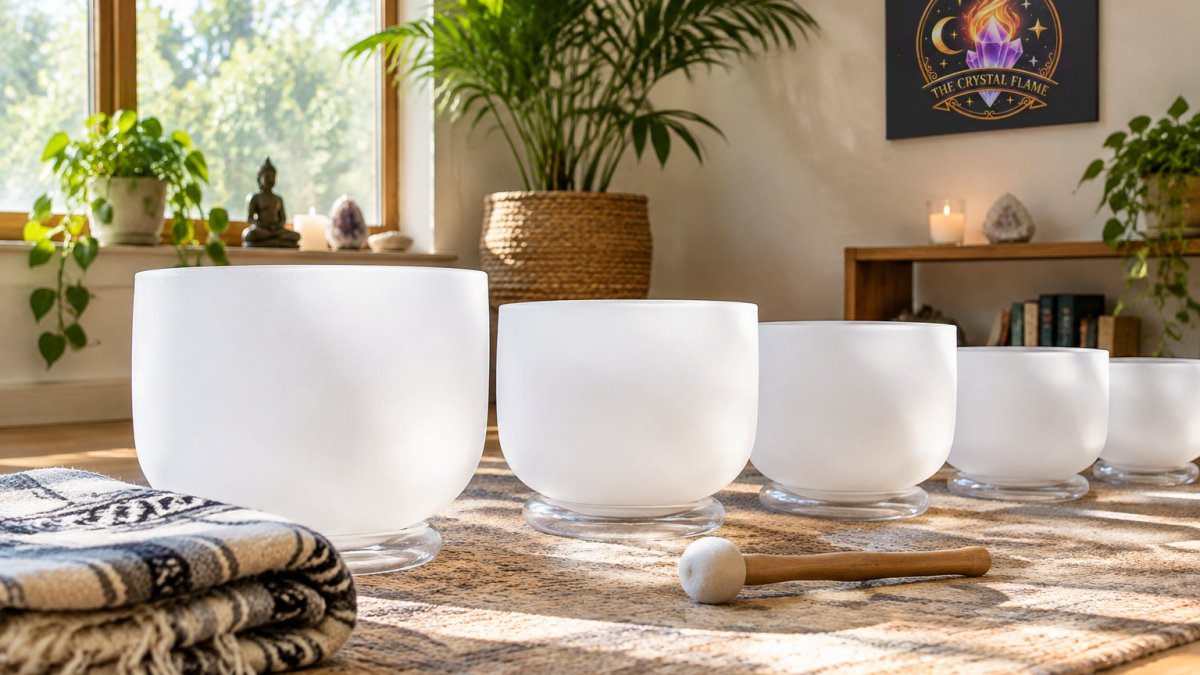
Singing bowls carry sustained tones and are the easiest entry point. Gongs produce a wide wash of overtones and need more space. Drums and rainsticks add rhythm and texture. Tuning forks give you precision and portability.
If you are building a practice rather than collecting, one instrument from two or three families covers far more ground than five bowls in the same key.
Singing Bowls: Crystal, Tibetan, and Himalayan
Crystal singing bowls are made from quartz and produce a clear, long-ringing tone. Tibetan and Himalayan singing bowls are metal, usually a bronze alloy, and produce a warmer, more complex sound with more overtones.
For crystal, purity and tuning are the two things worth checking. The 432 Hz Crystal Singing Bowl Chakra Set is tuned to the seven chakras across seven notes, and each bowl goes through quality control individually and as a set.
For metal bowls, ask about the alloy and the hammering. The Chakra Healing Tibetan Singing Bowl Set uses a special bronze alloy, made in India, with seven bowls and five mallets so you can experiment with different tones.
If you want to see genuine Himalayan material before you commit, browse our Himalayan smoky quartz crystal points and clear quartz crystal clusters, both sold by the piece or pound.

Gongs, Chimes, Drums, and Tuning Forks
Gongs are often a larger investment and can be harder to evaluate. Ask who made the instrument and where.
Chimes are generally an accessible starting point for testing whether you enjoy sustained metallic tones.
Frame drums and other hand drums raise a different question: animal skin or synthetic head. Neither is automatically more ethical. What matters is whether the seller tells you which it is.
Tuning forks are precision instruments, so look for sellers who state the frequency of each piece.
Ancient Sound Healing Instruments and Cultural Provenance
Ancient sound healing instruments come from living traditions, not dead ones. Singing bowls, gongs, and drums are still made and still used by the communities that developed them. That changes what respectful purchasing looks like.
Provenance is the documented history of an object: where it was made, by whom, and how it traveled to you. A bowl with clear provenance supports the maker.
The practical test is simple. Does the seller describe the tradition the instrument comes from with specificity and respect, or do they use it as atmosphere? Language like "ancient Tibetan wisdom" attached to a mass-produced item is a warning sign.
Sound Healing Instruments for Beginners: Start With Three Pieces
Sound healing instruments for beginners do not need to be expensive or numerous. Three pieces cover the core range: one sustained tone, one rhythmic element, and one precision tool.
Start with a singing bowl or a small set. The 432 Hz Pure Harmony Set pairs three quartz bowls in F4, D4, and C4 with two mallets and three silicone rings.
Add a rhythmic instrument to add texture to a session without buying more bowls.
For the grounding piece, our large clear quartz tumbled stones are sold by the piece or pound, and our large purple amethyst tumbled stones work well for anyone drawn to a calmer, more introspective tone.

A common mistake is buying a large matched set before you know what you enjoy playing. Three pieces tell you more about your own practice than seven ever will.
How to Buy Ethically Sourced Sound Healing Instruments Online
Buying ethically sourced sound healing instruments online comes down to reading the listing the way a skeptic would. The seller controls every word on the page, so look for the details that are hard to fake.
Start with the material specification. "High-quality quartz" is a mood. "99.99% pure white quartz" is a claim. One of these can be checked and the other cannot.
Next, look for tuning information. A serious seller states the frequency of each piece. The Solfeggio Crystal Singing Bowl Set lists its six frequencies, from 396 Hz through 852 Hz.
Then check the physical details. Weight, diameter, and what is included in the box tell you whether the seller has actually handled the product.
Finally, read the shipping and returns language.
Authenticity and Quality Checks Before You Pay
Run this checklist before you check out.
- Does the listing name the country or region of origin?
- Does it state the material or alloy specifically?
- Does it give a frequency, note, or tuning standard for each piece?
- Does it list dimensions and weight?
- Does it show the actual product, not only a stock image?
- Does it explain what is included: mallets, rings, cases, covers?
- Does it describe the maker or workshop in plain language?
- Is there a clear return policy if the piece does not resonate?
Watch out: listings that show a different bowl in every photo, or that crop out the mallet and rings, are often reselling generic stock. Ask for a photo of the exact piece you will receive before paying for anything expensive.
Comparing Sets, Sizes, and Total Cost of Ownership
Total cost of ownership means the full price of playing, not just the sticker price.
Here is how our own sets compare on the things that actually affect that total.
| Set | Price | Pieces Included | Best For |
|---|---|---|---|
| 432 Hz Pure Harmony Set | $769.00 | 3 quartz bowls, 2 mallets, 3 rings | Beginners building a first kit |
| 432 Hz Chakra Set | $1,590.00 | 7 quartz bowls 8"-14", 3 mallets, 7 rings | Full seven-note sound baths |
| Solfeggio Set | $1,599.00 | 6 quartz bowls, rod, mallet, 6 rings | Frequency-focused practice |
| Chakra Tibetan Set | $1,899.00 | 7 bronze bowls, 5 mallets, covers, felt rings | Warm metal tone, full chakra work |
| White Sound Therapy Set | $1,999.00 | 7 quartz bowls 6"-12", 4 mallets, 2 cases | Practitioners who travel |
Price
Two things drive the price difference: bowl size and what ships in the box. The 14" bowl in the 432 Hz Chakra Set is a large instrument.
If you are cost-conscious and comparing by weight, our selenite satin spar rough stones are sold by the piece or pound, which makes them an affordable way to add a grounding element without buying another instrument.

The question to ask is not "which set is cheapest" but "which set has everything I need on day one." A set with mallets and rings included usually wins that comparison.
Choosing Your First Set From The Crystal Flame
The Crystal Flame offers a curated collection of over 700 mystical products, including tarot and oracle decks, crystals, and sound healing instruments, chosen with intention for beginners and seasoned practitioners.
If you are just beginning, start with the 432 Hz Pure Harmony Set and its three matched quartz bowls. If you already run sound baths and want the full seven-note range, the 432 Hz Chakra Set gives you bowls from 8" to 14" with the mallets and rings included. And if a warm metal tone suits your practice better, the Chakra Healing Tibetan Singing Bowl Set brings seven handcrafted bronze bowls with five mallets to experiment with.
Get started with The Crystal Flame and explore the sound healing collection.
Sound healing rewards patience. The right first instrument will still be on your shelf in ten years, and the sourcing behind it will still matter then. Start with one honest piece, learn how it responds in your space, and let the rest of your kit grow from there.
Frequently Asked Questions
How can I tell whether sound healing instruments are ethically sourced?
Ask the seller four things: where the material comes from, who made the piece, whether the maker was paid directly, and what documentation exists. A trustworthy shop names the country of origin, describes the workshop or artisan relationship, and does not dodge the question with vague language about good energy. For crystal bowls, look for stated quartz purity and tuning standards. For bronze bowls, look for a named origin such as India and a description of the alloy. If a listing gives you no origin, no maker, and no material detail, that is your answer.
What are the best sound healing instruments for a complete beginner?
Start with three pieces rather than a full set. One crystal singing bowl in a mid size, one pair of chimes or a small frame drum, and a tuning fork give you tonal variety without a large outlay. The 432 Hz Pure Harmony Set at $769.00 is a practical entry point because the three bowls are already tuned to work together, and it includes mallets and silicone rings. Add a full seven-bowl set later once you know which tones you actually reach for.
Are handmade sound healing instruments better than mass-produced ones?
Handmade pieces usually carry more variation in tone and finish, and that variation is often the point. A handcrafted Tibetan bowl from India will not be identical to the next one, and the slight differences in weight and hammering shape the sound. Mass-produced instruments can be consistent and still well made, particularly kiln-fired quartz bowls where tuning is checked individually. Judge by stated tuning accuracy, material quality, and whether the seller describes their quality control, not by the handmade label alone.
What should I look for when buying a singing bowl online?
Check five details before you buy. First, the note and frequency, such as C4 at 256.87 Hz, so you know what you are getting. Second, the diameter in inches, since a 14-inch bowl fills a room differently than an 8-inch one. Third, the material, whether pure quartz or a bronze alloy. Fourth, what is included: mallets, silicone or felt rings, and cases. Fifth, the return policy. A seller who lists all five is telling you they test their stock.
Where is the best place to buy sound healing instruments online?
Buy from a seller who publishes origin, material, and tuning details on every listing, and who will answer a direct question about sourcing before you order. Specialty shops that curate a limited range tend to know their stock better than large marketplaces where the same listing is fulfilled by rotating suppliers. Check the shipping origin too.
