

Last Updated: October 26, 2026
Quick Summary
The best crystals for home decor are chosen by matching stone size, color, and hardness to each room's job: black tourmaline or obsidian for entryways, selenite or amethyst clusters for living rooms, and amethyst or rose quartz for bedrooms. Buy one anchor piece per room, check stated dimensions and weight, and keep water-soluble stones like selenite away from taps and nightstand water glasses.
- Place one anchor piece per room rather than five small pieces on the same shelf.
- Group three pieces of different heights on a tray, leaving a hand's width of empty surface.
- Skip selenite and raw salt in bathrooms and kitchens because they dissolve or shed moisture.
- Budget under $20 for a first piece, $20 to $50 for a cluster, and $100 and up for a large anchor.
- Anchor heavy pieces above waist height with museum putty and keep clusters away from children and pets.
Table of Contents
- Why Crystals Work as Home Decor
- Crystal Placement in the Home: A Room-by-Room Guide
- Large Crystals for Home Decor: Statement Pieces That Anchor a Room
- Crystals for Bedroom Decor: Calm, Soft Color, and Quiet Placement
- How to Arrange Crystals in Your Home Without Clutter
- Choosing Quality, Size, and Budget Before You Buy
- Cleaning, Care, and Safe Display
- Picking Your First Crystal Piece for the Room You're Working On
- Frequently Asked Questions
Why Crystals Work as Home Decor
A crystal is a mineral specimen whose natural geometry, color, and light reflectivity make it a decorative object in its own right.
The practical case is stronger than the mystical one. Crystals add texture and color without needing water, sunlight, or maintenance schedules. A cluster on a console table catches afternoon light; a tower on a nightstand gives a bedroom a soft point of interest.
Crystal Placement in the Home: A Room-by-Room Guide
Crystal placement in the home works best when you match stone size, color, and hardness to the room's job. Entryways want something sturdy and welcoming; living rooms want height and shine; bedrooms want soft color and quiet; bathrooms and kitchens want pieces that tolerate moisture and wipe down easily.
The feng shui layer, kept practical
Feng shui practitioners map the home into zones, entry, relationship corner, wealth corner, and assign stones to each. You do not need the whole system to borrow the useful part: it forces you to decide what each room is for before you decorate it. A common pattern places amethyst or rose quartz in the relationship and calm zones, black tourmaline or obsidian near the entry as a boundary, and clear quartz or selenite where you want light.
Room-by-room assignments
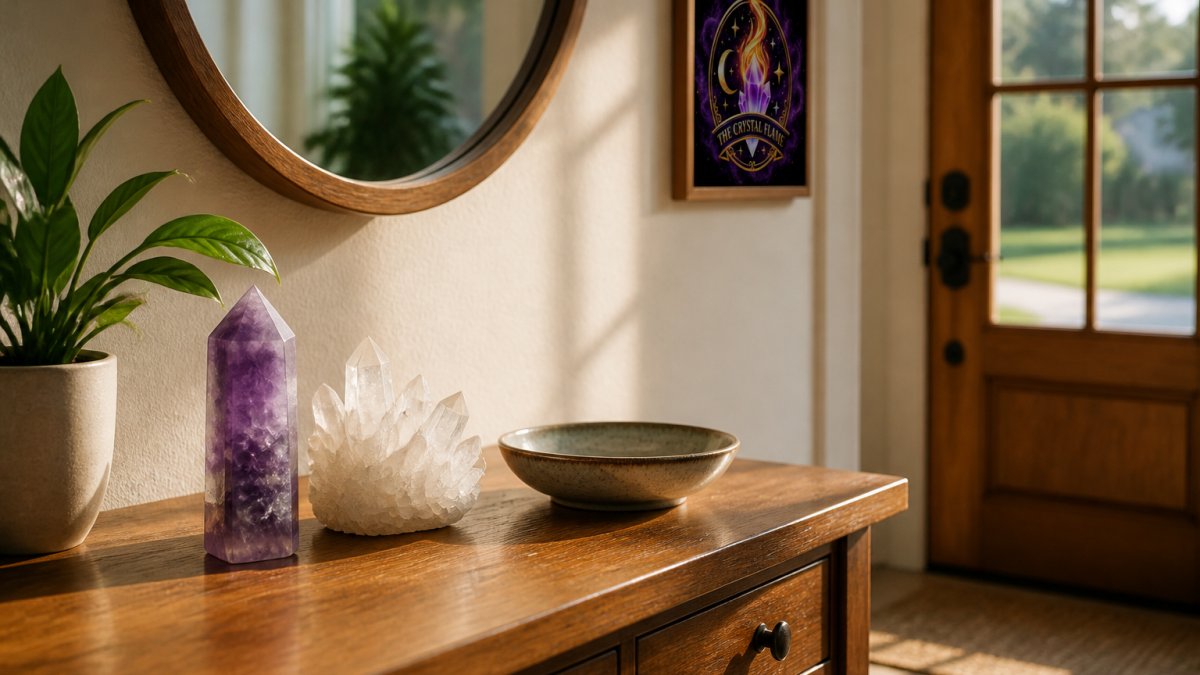
- Entryway and doorway: a single upright tower or small cluster where keys land. Black tourmaline or obsidian is the traditional doorway pick because the dark color reads as a boundary; clear quartz is the lighter alternative for a pale palette. Keep it on a stable tray.
- Living room: one larger statement piece on a coffee table or shelf, plus a low bowl of tumbled stones. A big selenite log or amethyst cluster earns its space here; height and reflectivity matter most.
- Bedroom: amethyst in soft, low light. Keep pieces small and away from where you set a water glass. Rose quartz is the traditional calm-and-love stone; see below.
Matching stone to room, not just to mood
A few practical pairings hold up regardless of belief:
- Dark, matte stones (black tourmaline, obsidian, basalt) anchor an entry or dark shelf and hide dust.
- Translucent stones (selenite, clear quartz, pale amethyst) throw light and suit rooms with afternoon sun.
- Warm-toned stones (citrine, pyrite, peach moonstone) suit wood and leather palettes; cool tones (sodalite, blue calcite) suit gray and white schemes.
Match each room's job to the right stone, color, and placement.
| Room | Stone options | Placement note |
|---|---|---|
| Entryway and doorway | Black tourmaline, obsidian, or clear quartz | Single upright tower or small cluster on a stable tray |
| Living room | Selenite log or amethyst cluster | One larger statement piece plus a low bowl of tumbled stones |
| Bedroom | Amethyst, rose quartz | Small pieces in soft, low light, away from water glasses |
| Home office | Clear quartz or pyrite | Near the desk, where shine reads as focus |
| Bathroom | Polished slabs or agate slices | Wipe clean and tolerate humidity; skip selenite and raw salt |
| Kitchen | Agate slices and polished towers | Small polished piece away from stove and sink splash zone |
Large Crystals for Home Decor: Statement Pieces That Anchor a Room
Large crystals for home decor do one job: they give a room a center of gravity. A single big piece reads as intentional.
Scale decides placement. A piece roughly the height of your forearm belongs on a console, low shelf, or sideboard, never on a floating shelf above eye level.
For a warmer, softer anchor, the Large Pink Amethyst Druzy Crystal Cluster is a standing freeform from Brazil, about 5 inches tall and 5 inches wide at 5.7 pounds, and the listing ships the exact item shown. At $195.00 it is the piece you buy once for a room you actually use.
Best for: a living room or dining room that needs one confident focal point. Skip if: you are still testing whether you like crystals in your space.
Crystals for Bedroom Decor: Calm, Soft Color, and Quiet Placement
Crystals for bedroom decor should be small, soft in color, and placed where you will not knock them over in the dark. Purple and pale pink stones recede into a calm palette instead of competing with it. Amethyst and rose quartz are the two stones most often associated with sleep, calm, and relationships, and two of the easiest to style in a bedroom. You can browse large amethyst points for a soft, quiet bedroom placement.
Which stones, and why
- Amethyst: the traditional calm-and-sleep stone, and practical because purple reads as quiet against most bedding palettes. A small tower or palm stone is enough.
- Rose quartz: the traditional love-and-harmony stone. Pale pink is the easiest color to work into a neutral bedroom, and a tumbled piece in a shallow dish doubles as a jewelry catch.
- Selenite: often used for cleansing or light, but water-soluble, keep it on a dresser, not a nightstand where a water glass lives.
Placement rules we follow
- One piece on the nightstand, not a cluster. You need the surface for a lamp and a phone.
- Keep raw, crumbly specimens off fabric. Druzy and rough points shed grit onto bedding.
- Skip anything sharp-edged at knee height or on the floor beside the bed.
For a smaller option, the Banded Purple Amethyst Crystal Point Tower stands about 1.75 to 2 inches tall and 0.75 inches wide for $15.00, which suits a narrow shelf. The Blue Sodalite Crystal Point Tower at the same size and price gives you a cooler tone if your bedroom palette runs toward soft blues and grays.
Styling a bedroom shelf without clutter
A bedroom shelf reads best with one anchor and one small companion, not a collection. Put the taller piece at the back, the smaller piece in front and slightly off-center, and leave the rest of the shelf empty. A shallow ceramic dish or small agate slice under the group keeps it from looking scattered. If your bedding is white or cream, a single amethyst tower is enough color; if your palette is busy, choose clear quartz or selenite and let texture do the work.
How to Arrange Crystals in Your Home Without Clutter
Arranging crystals without clutter comes down to three rules: odd numbers, mixed heights, and one material story per surface. Group three pieces of different heights rather than five of the same size, and repeat one color family so the group reads as a collection, not a pile.
Our working method:
- Clear the surface completely and put back only the objects you actually use.
- Pick one anchor piece, the tallest or heaviest.
- Add two supporting pieces at roughly half and one-third the anchor's height.
- Put the group on a tray or slab so it reads as one object.
- Leave at least a hand's width of empty surface around the group.
A polished agate slice is the tray. The Large Agate Slice runs 4.5 to 5 inches across in dyed colors for $15.00, and doubles as a coaster or place card at a dinner table.
Large Pink Amethyst Druzy Crystal Cluster Standing Freeform Select Polished →
Watch out: sunlight through a clear sphere or polished slab can concentrate light and scorch a windowsill. Keep rounded, lens-like pieces out of direct afternoon sun.
Choosing Quality, Size, and Budget Before You Buy
Quality in decorative crystals comes down to three checks you can make from a listing photo: whether the piece is natural or treated, whether the seller shows the exact item, and whether size and weight are stated. Buy the size, not the photo, a wide-angle styled shot makes a 2-inch tower look like a 6-inch one.
Our buying checklist:
- Does the listing state height, width, and weight in inches and pounds?
- Does it say whether you receive the exact item or a similar one?
- Is any treatment disclosed, such as heat or pressure treatment?
Budget tiers we see work well: under $20 for a first piece or gift, $20 to $50 for a cluster or set, and $100 and up for a single large anchor.
On treatment: the Citrine Druzy Crystal Cluster box flat is $25.00 for a 2-pound flat of clusters averaging 0.5 to 1.5 inches, and the listing states plainly that this citrine is made from pressure-treated amethyst. We would rather show that note than hide it.
Cleaning, Care, and Safe Display
Care for most decorative crystals with a dry or barely damp soft cloth and keep them out of prolonged direct sun and standing water.
Stone-by-stone notes:
- Quartz and amethyst: dust dry, wipe with a damp cloth, dry immediately.
- Selenite and satin spar: never rinse. Wipe with a dry cloth only, because these dissolve in water.
- Pyrite: keep dry. Moisture encourages rust on iron-based specimens.
Safe display matters as much as cleaning. Anchor heavy pieces with museum putty if the shelf is above waist height.
For a low-maintenance shelf piece, the Selenite Satin Spar Crystal Standing Tower is 4 inches tall and 1.5 inches wide for $15.00, and needs nothing more than a dry dusting.
Picking Your First Crystal Piece for the Room You're Working On
Start with the room you actually spend time in, then pick one piece at the size that room can hold.
If you already know the room, buy the anchor instead.
Wherever you start, buy from a shop that states sizes, discloses treatments, and accepts returns. Every piece in our collection is chosen with intention, and our listings state dimensions and treatment notes so you know what arrives.
Frequently Asked Questions
Where should you place crystals in your house?
Start with the rooms you use most. An entryway console gets a clear quartz cluster or a small tower to greet you at the door. A living room shelf or coffee table suits a larger cluster or a geode slice. Bedrooms work best with quieter pieces like amethyst or selenite, kept on a nightstand or dresser rather than in the middle of the bed. Avoid full afternoon sun on dyed or softer stones, and keep anything breakable out of reach of pets and kids.
Which crystals work best for home decor?
Clear quartz clusters, amethyst towers and druzy clusters, selenite towers and wands, and agate slices cover most rooms. Clear quartz reads neutral and fits almost any color palette. Amethyst adds purple and works as a focal point. Selenite brings a soft white that lifts darker corners. Agate slices lie flat, so they suit coffee tables and shelves where a standing piece would feel crowded. Pick shapes that match the surface: towers for narrow ledges, clusters for open tabletops.
Are large crystals for home decor worth the higher price?
A large piece does more visual work than three small ones, so it often replaces several purchases. A 5-inch pink amethyst druzy cluster at $195 anchors a console or shelf on its own, while a $15 to $25 tower or small cluster fills a gap beside it. If you are styling one focal spot, buy the largest piece your budget allows and add smaller stones around it. If you are filling several rooms, start small and upgrade the piece you look at most.
What crystals should you avoid putting in the bedroom?
Skip anything visually loud or physically fragile near the bed. Very large clusters take up nightstand space and can be knocked over in the dark. Selenite is soft and water-soluble, so keep it away from humidifiers and open windows. Dyed agate slices can fade in strong direct sun. If you want a bedroom piece, choose a compact amethyst tower or a small selenite tower on a stable surface, and keep the statement cluster in a living space instead.
How do you arrange crystals in a room without it looking cluttered?
Work in odd numbers and vary the heights. Group three pieces of different sizes, such as a tall selenite tower, a mid-size amethyst tower, and a flat agate slice, on one tray or shelf. Leave empty space around the group so each stone reads as intentional. Repeat one material or color across the room so the display feels connected. Keep clusters on open surfaces and towers on narrow ledges, and clear everything else off the surface before you start.
The hardest part of decorating with crystals is not finding stones. It is stopping at one good piece per room instead of buying a shelf full you never look at. The Crystal Flame carries a curated collection of more than 700 mystical products, with crystals sized and photographed honestly so you can judge scale before you buy. Browse the collection, start with the room you use most, and sign up for our newsletter for placement ideas and new arrivals.
